
Chicago Women in the Arts: Visibility, Voice, and the Power of the Room

On March 8 — International Women’s Day — the room was full.
By the time the evening began, every chair at the Second Sunday Salon had been claimed. Conversations rippled through the space, glasses clinked, strangers became neighbors. That familiar hum before a performance — anticipation, curiosity, a sense that something meaningful is about to unfold — filled the room.
The theme of the evening was Chicago Women in the Arts, and the program brought together photography, jazz, and storytelling. But what unfolded that night was more than a performance.
It was a gathering.
One of the things I have learned over the years as an artist, producer, and founder of True Muse Arts is that rooms matter. The spaces we create — and the people we invite into them — shape the stories that can be told there.
Historically, women’s contributions to the arts have often been overlooked or minimized, even while shaping culture in profound ways. from-eblast-about-event
The Salon exists, in part, to push against that history — not through grand declarations, but through the simple act of creating spaces where women artists can stand at the center of the room.
On March 8, that room was alive.
The Power of Being Seen
Photographer Lesley Whitehead presented selections from her portrait series Women 50+, a body of work that quietly but firmly challenges a cultural narrative many women recognize — the idea that as women age, they should soften, shrink, or fade from view.
Whitehead’s portraits refuse that narrative.

The women in these photographs meet the camera with clarity and authority. They carry the weight of experience — resilience, humor, survival, and self-knowledge — and the images insist that those qualities deserve to remain visible.
What made the exhibition even more meaningful is that this was the first time Lesley had ever publicly shown her work.
My decision to invite her to exhibit at the Salon grew directly out of a personal experience.
Not long ago, I participated in a photographic session with her — the first time in my life I had worked with a female photographer. It was, without question, the best photographic experience I have ever had.
Part of that comes from her technical mastery. But the deeper difference was something more intuitive.
She truly saw me.
Not simply the performer or the curated persona one often brings to a camera, but the whole person behind it.
That kind of seeing is rare. And when it happens, it changes the work.
Experiencing that shift myself made me immediately curious about how she sees other women — which is exactly what led me to invite her to share Women 50+ with the Salon audience.
Looking at the portraits that evening, it was clear that the same clarity of vision shaping my own experience lives throughout the entire series.
And in many ways, that spirit — the act of truly seeing one another — is exactly what the Salon itself is meant to create.
Encouraging the Leap
The musical centerpiece of the evening came from drummer Sarah Allen, who presented her project Art for Art’s Sake, exploring the music of Wayne Shorter, Lee Morgan, Freddie Hubbard, and other jazz innovators.
When Sarah first shared the idea with me, I remember the excitement in her eyes.
I also remember the hesitation.
Like many extraordinary musicians, Sarah had spent years as a collaborator — what the jazz world calls a “sideman.” She had built a respected career supporting the musical vision of others.
But she had never led her own band.
So I encouraged her to take the leap.
On March 8, she did exactly that.

The ensemble — Brian Gephart, James Davis, Rachel Castellanos, Julie Wood, Steve Million, Stacy McMichael, and Sarah Allen on drums — delivered a performance that was confident, dynamic, and unmistakably alive. The room responded immediately.
By the end of the set, the musicians were already talking about the next performance.
Those are the moments that remind me why spaces like the Salon matter. When artists are given room to experiment and lead, new chapters begin.
Humor, Honesty, and the Loose Chicks
The evening’s spoken word performances brought a different kind of energy to the stage.
Roberta Miles appeared alongside two fellow performers from Loose Chicks, each presenting original autobiographical monologues they had written and performed themselves.
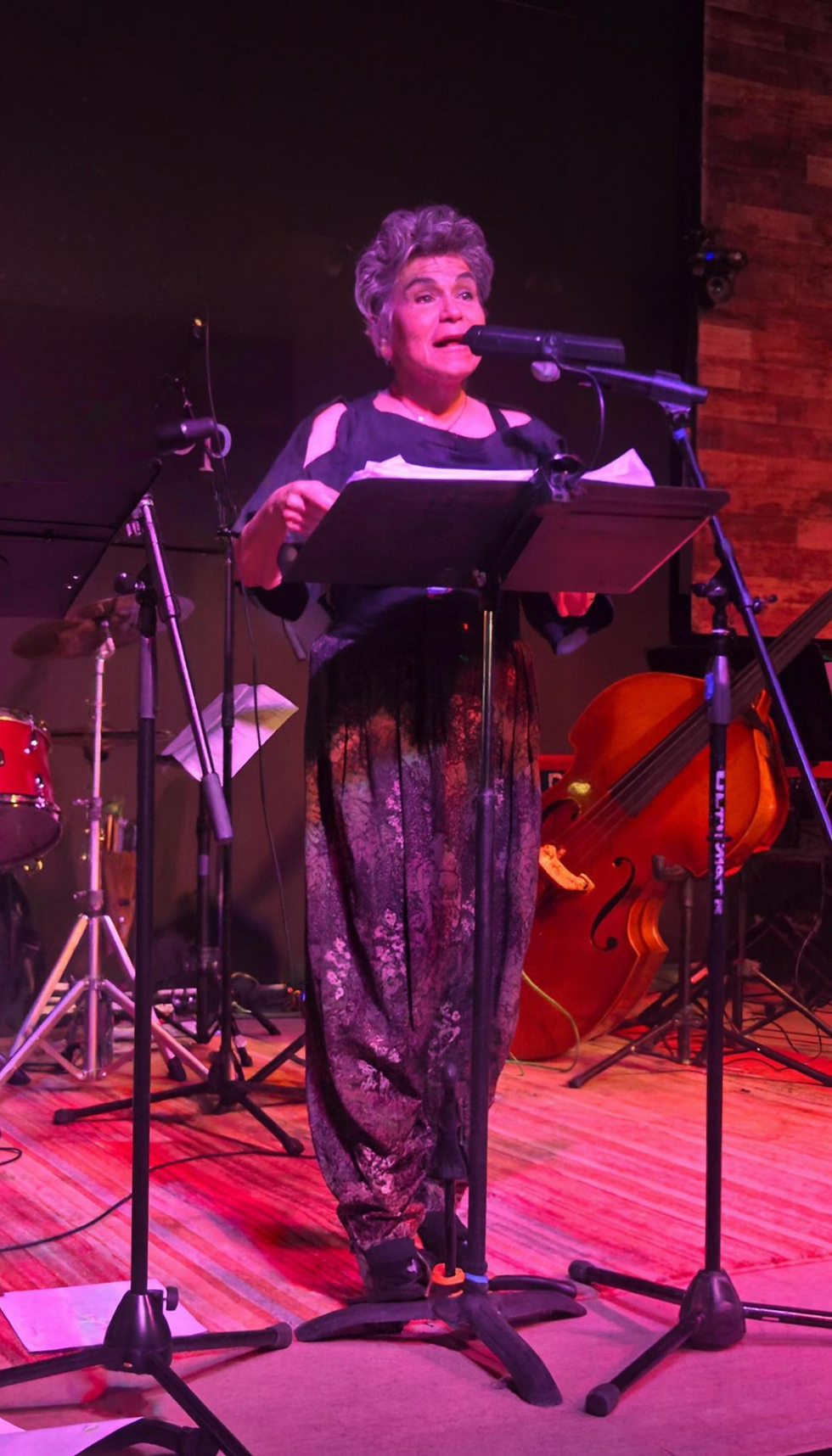
The pieces were hilarious — brutally funny at times — but also deeply revealing.
Through stories about aging, motherhood, mental health, self-doubt, romantic misadventures, and the relentless pressure to live up to society’s expectations, the performers spoke to experiences that many women quietly carry.
The laughter in the room was immediate.
So was the recognition.
The Loose Chicks have long understood something essential about storytelling: humor opens the door for truth. And when those truths are shared publicly, they create connection.
Gratitude and Transition
This Salon was also a moment of transition.
For the past two years, The Print Shop has provided generous in-kind support that allowed the Second Sunday Salon series to grow into the vibrant community gathering it has become.
March 8 marked our final performance in that space.
Their partnership helped create countless evenings of music, art, conversation, and creative discovery. We are deeply grateful for the generosity and spirit they brought to the work.
But as one chapter closes, another begins.
The Salon Continues
The Second Sunday Salon continues on April 12, 2026, when we return to Colvin House.
April is National Poetry Month, and the evening will celebrate the extraordinary literary voices of Chicago with a gathering of poets curated by Lynn Fitzgerald.

The program will also feature:
MUSIC: Latin Jazz with Joe Rendon (above) & Friends
ART: Paintings by Tigerlily Cross
Then in May, the Salon enters an exciting new phase.
True Muse Arts will begin presenting in partnership with Segundo Ruiz Belvis Cultural Center (SRBCC) — the longest-standing Latiné cultural center in Chicago and an organization whose work in community-based arts and cultural programming has shaped the city’s creative landscape for decades.
New rooms. New collaborations. The same commitment to building spaces where artists and audiences can meet.
Why We Keep Building the Room
If the March 8 Salon offered one clear reminder, it is this:
When artists gather in a space built on curiosity, courage, and mutual respect, extraordinary things happen.
New leaders step forward.
Stories that might have remained private are spoken aloud.
Communities deepen.
And the room itself becomes something more than a venue.
It becomes a place where art — and the people who create it — can truly be seen.


Comments